
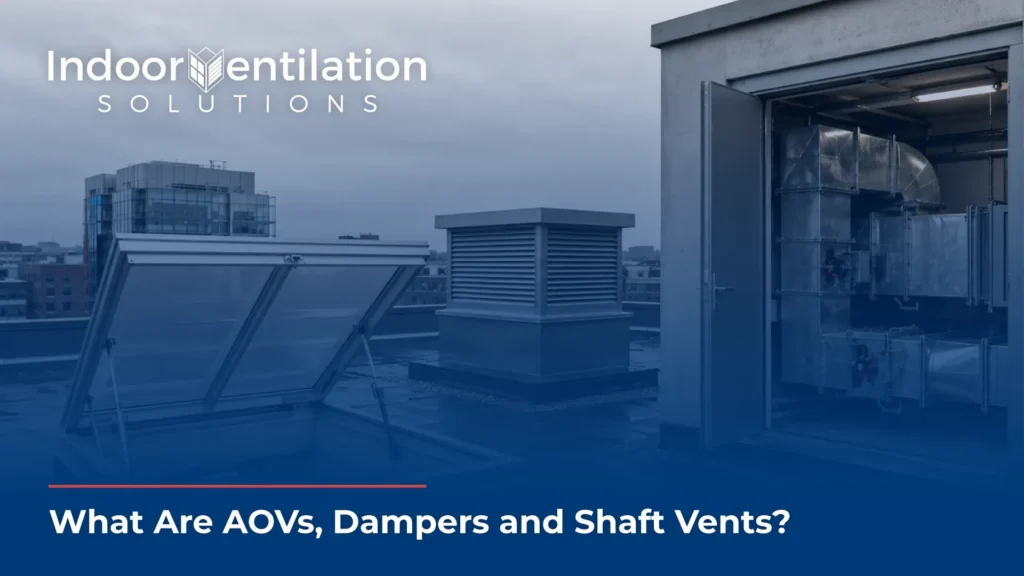
A specifier’s guide to how they work together and what gets them wrong on site.
If you are specifying or procuring a smoke ventilation system and keep encountering the terms AOVs, dampers and shaft vents, this article will give you a clear, practical understanding of what each component is, how they work together, and why getting them right matters from both a regulatory and life-safety standpoint.
AOVs: Automatic Opening Vents
An AOV, or automatic opening vent, is a window, rooflight or vent that opens automatically when triggered by a smoke detector, heat sensor or a manual control panel. The primary function of an AOV is smoke ventilation. In the event of a fire, smoke rises and accumulates rapidly at ceiling level. An AOV provides a controlled escape route for that smoke, maintaining a clearer layer of air at lower levels to support evacuation and firefighter access.
AOVs are most commonly found in stairwells, corridors, lobbies and atria. In residential and commercial buildings across Ireland, they form a critical part of the passive ventilation strategy required under fire safety regulations. They can be installed in roof positions for smoke extraction from above, or in facade positions to allow cross-ventilation where the building layout demands it.
The activation sequence is straightforward. A smoke detector triggers a signal to the control panel, which sends a command to an actuator fitted to the vent. The actuator opens the AOV within seconds. Once the event is resolved, the system resets and the vent closes. That entire sequence is designed to require no human intervention, which is the point.
When that sequence works, people evacuate safely. When it fails, the cause is almost always a specification or installation error that could have been identified before the system was ever commissioned.
Natural AOV systems rely on the stack effect, where hot smoke rises and exits through high-level openings while cooler replacement air enters at low level. Mechanical AOV systems use powered fans to force air movement where natural ventilation alone is not sufficient. The choice between the two depends on building height, geometry, occupancy type and the smoke control strategy agreed at design stage.
Smoke Dampers and Smoke Control Dampers
A smoke damper is a controlled closure device fitted within a duct or an opening in a fire-rated wall or floor. Its job is containment rather than extraction. Where an AOV exhausts smoke out of the building, a smoke damper prevents smoke from migrating through the ductwork or structural openings into areas it should not reach.
In normal operation, a smoke damper sits open to allow airflow through a ventilation or air conditioning system. When smoke is detected, the damper closes, sealing the penetration and preventing the spread of smoke through the building’s mechanical infrastructure.
Smoke control dampers are a specific subcategory, often integrated into smoke control systems rather than general HVAC networks. They are tested and certified for use in smoke control applications and must meet the performance requirements set out in EN 12101, the European standard governing smoke and heat control systems. The distinction between a general fire damper and a smoke control damper is one worth understanding at specification stage. They are not interchangeable and they serve different functions under the standard.
Correct placement of smoke dampers is determined during the smoke control system design phase. This typically involves input from the project engineer, the fire strategy consultant and the specialist ventilation contractor. Getting the positioning wrong is not a minor error. It has direct implications for compartmentation, regulatory compliance and the integrity of the overall fire strategy.
Shaft Vents and Smoke Shaft AOVs
A smoke shaft is a vertical duct within a building designed specifically to channel smoke from fire floors upward and out of the building. The shaft vent, or smoke shaft AOV, is the component at the top of that shaft. It opens on activation to allow the accumulated smoke to discharge at roof level.
Smoke shafts are particularly common in multi-storey residential buildings and mixed-use developments where stairwell pressurisation or corridor smoke control is required. The shaft itself is a fire-rated enclosure. On each floor, a smoke shaft damper is positioned in the wall of the shaft at corridor level. Under normal conditions, all floor-level dampers are closed. When a fire occurs on a given floor, only the damper on that floor opens, directing corridor smoke into the shaft. The shaft vent at the top opens simultaneously, drawing the smoke upward through the stack effect and exhausting it at roof level.
This system keeps smoke off the escape routes on unaffected floors. It is a fundamental part of the compartmentation strategy in buildings that cannot rely on direct external openings at every level.
How These Components Work as a System
AOVs, dampers and shaft vents are not independent products. They are components within a coordinated smoke control system, all communicating through a central smoke control panel. When one element activates, the others respond accordingly.
A poorly coordinated system, where components are sourced, specified or installed without regard for the overall control logic, will fail the commissioning process and may not perform as intended in a real fire event. This is why supply-and-fit by a specialist contractor matters. The technical submittal, compliance documentation and system approval that go with a properly delivered smoke ventilation system exist precisely because the components only perform correctly when they are integrated correctly.
If you are at design stage, in procurement, or reviewing a current specification, the right time to get specialist input is before the detailed design is fixed, not after the problems surface on site.
Indoor Vent supplies, installs and maintains smoke and natural ventilation systems across Ireland. If you have a project at design stage or in procurement, send us your drawings and we will come back to you with a clear view of what the system needs.