
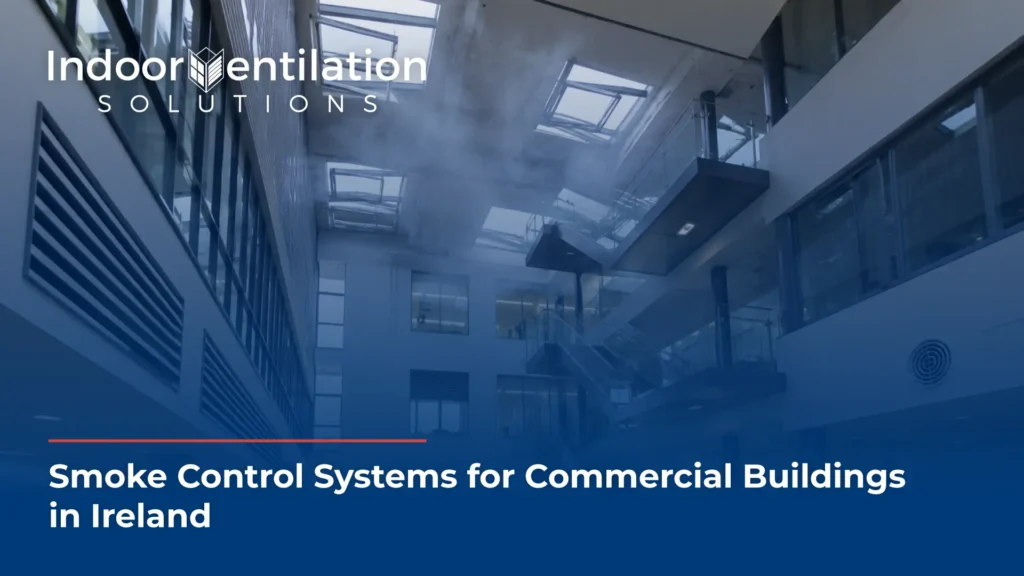
Smoke control systems for commercial buildings in Ireland are not optional features. They are life safety infrastructure, and in most commercial building types, they are a regulatory requirement under Irish building regulations and the associated Technical Guidance Documents. If you are developing, managing, or refurbishing a commercial building in Ireland and smoke ventilation is not yet part of your brief, it should be.
This article covers how these systems work, what Irish regulations expect, the main components involved, and what proper installation and maintenance actually looks like in practice.
What a Smoke Ventilation System Is Actually Doing
The purpose of a smoke ventilation system is not simply to remove smoke from a building. It is to keep escape routes clear long enough for occupants to evacuate safely and for firefighters to move through the building without being blinded by hot gases.
Smoke is the primary cause of death in building fires, not direct flame contact. A well-designed smoke extract system creates a clear layer at low level, pushes hot gases and combustion products toward designated exhaust points, and maintains visibility along corridors, stairwells, and exit routes.
The system does this by creating deliberate pressure differentials across the building, using a combination of extraction points, smoke dampers, automatic opening vents, and in some cases mechanical fans. The design has to account for the type of building, floor plan, occupancy load, and the likely fire scenarios that could occur within it.
This is not a product you pick off a shelf. It is an engineered solution.
Irish Regulatory Requirements You Need to Understand
In Ireland, commercial building fire safety is governed primarily by Technical Guidance Document B (TGD B), which sets out how the Building Regulations 2022 apply to fire safety in buildings. Smoke ventilation provisions sit within Part B, which covers means of escape, fire spread, and access for fire services.
For smoke ventilation systems specifically, EN 12101 is the relevant European standard. It covers smoke and heat control systems across a series of parts, addressing everything from natural smoke and heat exhaust ventilators to powered smoke exhaust fans and differential pressure systems.
Any system installed in a commercial building in Ireland must be designed, installed, and commissioned in accordance with EN 12101 to be considered suitable for regulatory purposes. It is also worth noting that for ongoing compliance, systems require regular inspection and maintenance. A system that was installed correctly five years ago but has never been serviced is not a compliant system.
The Main Components of a Commercial Smoke Control System
Understanding the components helps you ask better questions when you are briefing a supplier or reviewing a proposal.
Automatic Opening Vents
AOVs are typically located in the roof or high in external walls. When triggered, they open automatically to allow smoke and heat to exit the building. In a natural smoke ventilation system, they rely on buoyancy: hot gases rise and escape through the vent while cooler air enters at low level. Roof AOVs are among the most commonly specified components in Irish commercial buildings, particularly in atria, stairwells, and large retail or warehouse spaces.
Smoke Dampers
Smoke dampers are installed within ductwork and at wall or floor penetrations. Their job is to prevent smoke from migrating through the building’s ventilation system and into areas that are not yet affected by the fire. A fire damper closes to restrict fire spread; a smoke damper responds to smoke detection and closes or opens depending on how the smoke management system is configured. Understanding the difference matters at the design stage.
Smoke Extract Fans and Mechanical Systems
Where natural ventilation is not sufficient, or where building geometry makes it impractical, mechanical smoke extraction is used. Axial fans and centrifugal fans rated for high-temperature operation draw smoke through dedicated ductwork to exhaust points. These systems require careful integration with the building’s HVAC layout and must not compromise daily ventilation performance.
Control Panels and Smoke Management Systems
Every system requires a control panel that receives signals from fire detection, triggers the appropriate AOVs and dampers, and logs system status. In larger buildings, this becomes a full smoke management system (SMS) that coordinates multiple zones, manages pressure differentials between compartments, and integrates with the building’s fire alarm panel.
Natural Ventilation Versus Mechanical Smoke Extract
The decision between natural and mechanical smoke extraction is not simply a cost question, though cost is a factor. It is a design question that has to be resolved against the building type, height, geometry, and intended use.
Natural ventilation works by buoyancy. It is passive, requires no power to operate the vents themselves, and is generally lower in maintenance cost over the long term. It is well suited to single-storey commercial buildings, warehouses, large retail units, and low-rise multi-storey buildings where there is adequate height for smoke stratification to occur.
Mechanical smoke extraction is appropriate where natural ventilation cannot achieve the required exhaust rate, where the building is in a location with high external wind pressure that could compromise natural vent performance, or where the building type demands more precise pressure control, such as underground car parks, multi-storey atriums, or complex mixed-use developments.
Many buildings use a combined approach, with natural ventilation handling daily fresh air requirements and mechanical systems taking over in the event of a fire.
Installation, Commissioning, and Ongoing Maintenance
A smoke ventilation system that has been correctly designed but poorly installed is a risk, not a safeguard. The installation phase requires qualified engineers who understand both the technical requirements of the system and the realities of the building being worked on.
After installation, commissioning is the process of testing the system under controlled conditions to verify that it performs as designed. This includes testing AOV operation, checking damper control response times, confirming fan performance at rated temperature, and verifying that the control panel responds correctly to simulated fire scenarios.
Once a system is commissioned, it does not maintain itself. EN 12101 and Irish fire safety legislation both require periodic inspection and maintenance. In practice, this means a minimum of annual inspection for most system types, with some components requiring more frequent checks. Maintenance contracts exist to ensure that when an inspection reveals a fault, it is addressed and documented before it becomes a compliance issue or, more importantly, a failure point during an actual fire.
Deferred maintenance is the single most common reason that otherwise well-designed smoke ventilation systems fail to perform as intended. A system that fails inspection can trigger enforcement notices, delay occupancy sign-off, and in the event of a fire, create significant liability exposure for the building owner or responsible person.
What to Ask When Specifying a System for Your Building
If you are a facilities manager, project developer, or architect working on a commercial building in Ireland, the specification conversation for smoke ventilation should cover a few specific areas.
You need to know whether the proposed system is designed to EN 12101 and whether the installer can provide documentation confirming this. You need to understand how the system integrates with your existing fire detection and alarm infrastructure. You need a clear picture of what commissioning will involve and what documentation you will receive. And you need to understand what ongoing maintenance looks like before you sign off on the installation.
The right provider will answer these questions without hesitation. They will also flag complications early rather than discovering them on site.
Speak to the Indoor Vent Team
Indoor Vent designs, supplies, installs, and maintains smoke and natural ventilation systems for commercial buildings across Ireland. The team works with architects, engineers, facilities managers, and developers at every stage, from initial specification through to commissioning and long-term maintenance contracts. Since 2015, the company has delivered smoke and natural ventilation projects across education, public sector, and private commercial development, including work for universities, government bodies, and property developers across the island of Ireland.
If cost, timeline, or disruption to your project programme are concerns, those are exactly the conversations that happen at the site visit stage. There are no surprises after the proposal is issued.
If you have a project in development or an existing system that has not been serviced, the starting point is a conversation. Call Indoor Vent directly to discuss your building and what the right solution looks like for your specific situation.