
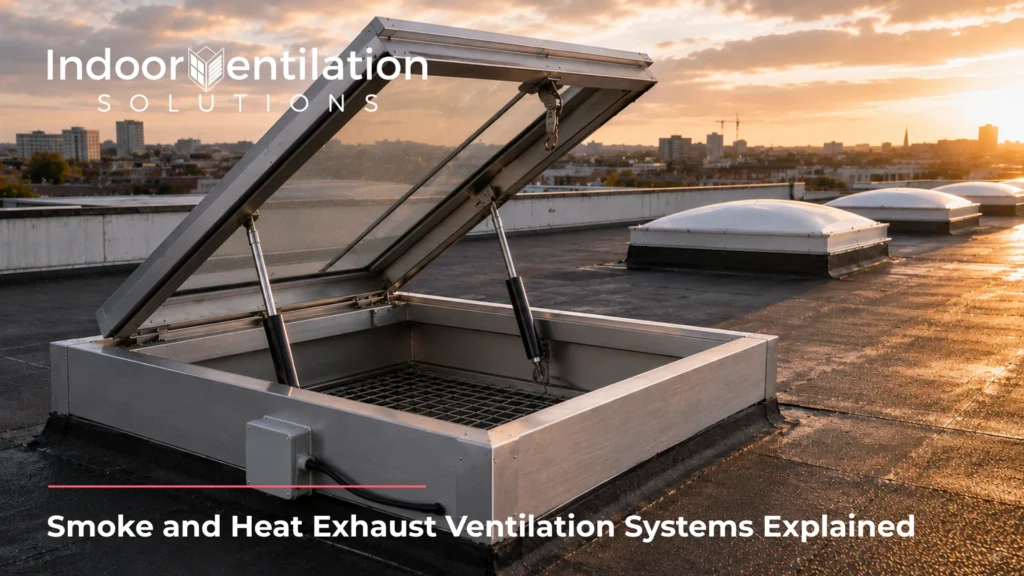
A smoke and heat exhaust ventilation system removes smoke and hot gases from a building during a fire, keeping escape routes clear long enough for people to get out and firefighters to get in. That’s the short version. The longer version is the reason most people searching this term end up more confused than when they started, because “SHEV” gets used loosely to describe several different technologies that behave in very different ways during an actual fire.
If you’re specifying, maintaining, or simply trying to understand what sits above your ceiling, that difference matters more than most guides admit.
How Do Smoke and Heat Exhaust Ventilation Systems Work?
Smoke rises because hot gas is less dense than the cooler air around it. That’s buoyancy, and it’s the physical principle every smoke and heat exhaust ventilation system is built around: intercept the smoke layer before it reaches head height, and vent it out through the roof, a shaft, or a façade opening before it thickens.
Left unmanaged, that layer carries the toxic gases responsible for most fire fatalities. Smoke inhalation, not flame, is what kills people in the majority of building fires.
That’s the theory. Whether your system actually does this today, on demand, is a separate question, and it’s one worth answering before a fire forces the point.
Natural Smoke Extraction vs Mechanical Extraction
There are two ways to move that smoke layer out of a building, and the distinction gets glossed over constantly.
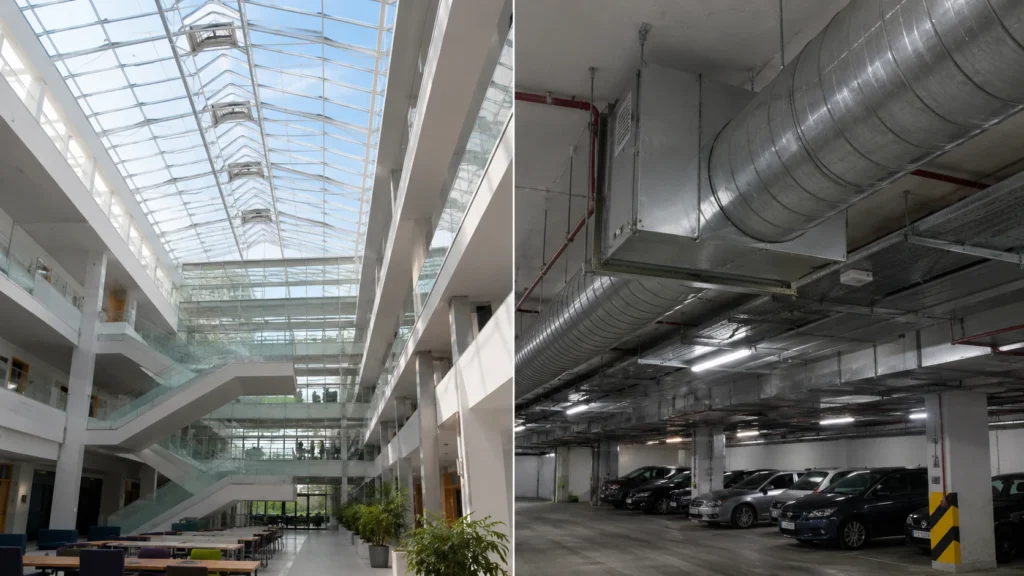
Natural smoke extraction relies on the same buoyancy that created the problem. Vents open at high level, smoke rises through them, and cooler air is drawn in below. No fans, no ductwork, no mechanical plant, just a simple system with few moving parts to fail, the kind you find in a university lecture theatre or campus atrium.
Mechanical smoke extraction steps in when buoyancy alone isn’t enough, in car parks, basements, and plant rooms with no clean vertical route, the same spaces sitting below those campus atria. Fans and ductwork pull smoke out at a controlled rate regardless of building shape. It costs more, but it solves problems natural systems physically can’t.
Neither approach is universally better, the right one depends on the building’s layout. For the full breakdown, see our commercial smoke control guide. Choosing correctly is only half the job. None of it matters if the system doesn’t activate when it’s needed.
What Triggers a Smoke and Heat Exhaust Ventilation System?
If you’re accountable for a building when its alarm goes off, you need to know what actually makes the vents open, not just that they should. Most systems are triggered by a combination of automatic detection and manual override. A vent that never opens is not a system, it’s a design drawing.
Heat detectors and dedicated fire alarm systems provide automatic activation, opening vents the moment sensors confirm a fire without waiting for a person to react. Manual call points sit alongside them, so fire wardens and occupants can trigger the system directly if detection is delayed or a fire is spotted first.
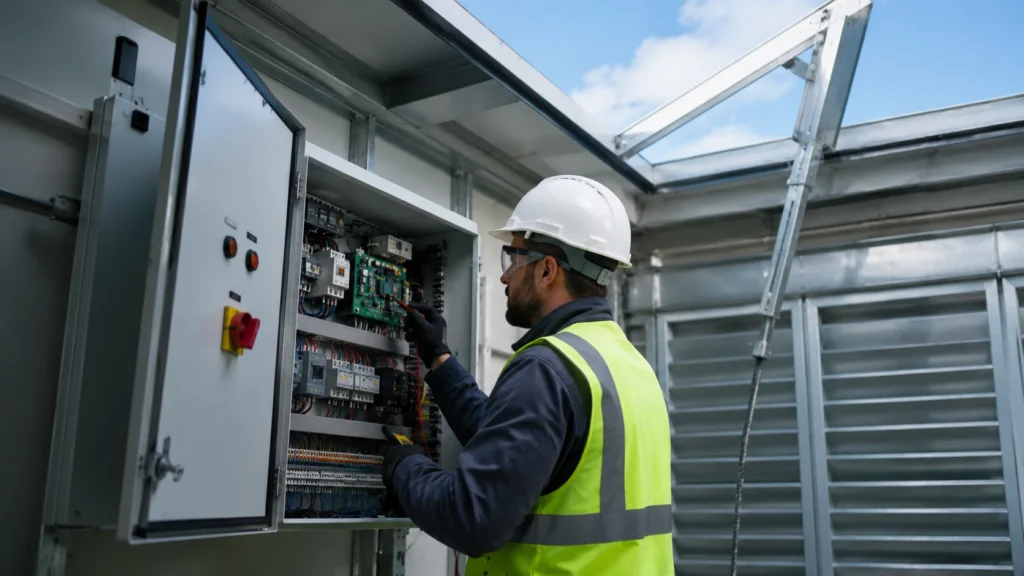
A properly designed control panel manages this handoff and confirms the vents have actually opened, rather than assuming the command worked. This is the kind of control panels and detection equipment we install as standard, and that confirmation matters more than most non-specialists realise. Fire safety plans assume the system activates, not hope for it. If it doesn’t, every escape route marked on that plan becomes a diagram of what should have happened, not what did.
Is Smoke Ventilation a Legal Requirement in Ireland?
Not a paperwork exercise. In Ireland, smoke ventilation is a regulatory obligation tied directly to Technical Guidance Document B and the fire safety strategy signed off for a building.
The relevant EN 12101 series of standards covers the components involved, from natural smoke and heat exhaust ventilators through to the fans used in mechanical extraction, and these standards inform how systems are designed, specified, and tested.
A lot of buildings quietly fall short here. A system installed correctly on day one can drift out of the specification it was designed against, whether through building alterations, ageing components, or vents that no longer open to their original tested performance.
Do Smoke and Heat Exhaust Ventilation Systems Need Maintenance?
A smoke and heat exhaust ventilation system that isn’t maintained is a liability dressed up as a safety feature. Vents seize. Sensors drift out of calibration. Control panels develop faults that go unnoticed because the system only activates during an actual fire, not during a normal working day.
This is the part of SHEV systems that gets the least attention and matters the most. Design and installation get the credit. Servicing decides whether the system still performs to spec months or years later, when it’s genuinely called on.
The question worth asking about a system that’s already installed isn’t whether it was compliant when fitted. It’s when it was last tested, and by whom. If you can’t answer that with confidence, you’re trusting a system to perform exactly when you need it most, without knowing if it still can.
We supply, install, and maintain smoke and heat exhaust ventilation systems across Ireland, working with our smoke ventilation specialists for education, public sector, and commercial buildings where getting this right isn’t optional.