
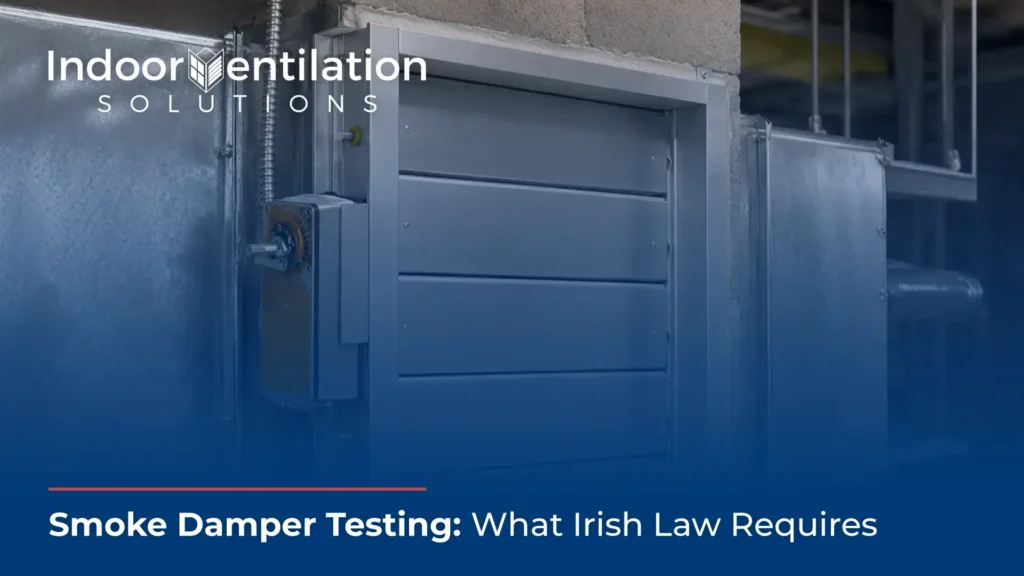
Smoke damper testing in Ireland is not optional once a building’s fire safety strategy includes smoke control. If smoke dampers form part of that strategy, they have to be tested and kept working for as long as the building is occupied.
That obligation is the easy part. What catches most building owners out is that smoke dampers are governed by a different standard to fire dampers, tested differently, and inspected differently. Treat them as the same thing, and that’s exactly where a fire risk assessment will find the gap in your compliance.
What’s the Difference Between a Fire Damper and a Smoke Damper?
Most maintenance contractors talk about fire and smoke dampers in the same breath, and most building owners assume they’re interchangeable. They are not.
A fire damper is built to IS EN 15650 and tested to EN 1366-2, and it’s the older, more familiar piece of fire protection equipment in most HVAC ventilation systems. It sits passively in the ductwork until heat triggers a fusible link, at which point the blade or shutter closes to hold the fire rated separation between compartments. No electronics, no signal, just a physical response to temperature.
A smoke damper works on a different principle entirely. It’s tested and classified under EN 12101-8, the standard specific to smoke control dampers, and it closes on a signal from the fire alarm system or smoke detection network rather than on heat alone. That signal-driven actuation is what allows smoke dampers to resist the passage of smoke through a duct route the moment smoke is detected, ahead of any thermal trigger.
The point of that early response is to keep low-level escape routes clear of smoke and reduce damage to the building, not just to satisfy a test certificate.
The practical result: a fire and smoke damper combination unit has to satisfy both testing regimes. Fire damper testing and smoke damper testing are not the same job, even when they happen on the same site visit, and a lot of inspection and testing paperwork in Ireland quietly falls short because both get treated as one set of testing procedures.

What Does Irish Law Require for Smoke Damper Testing?
Irish building regulations don’t leave smoke control as optional once it’s part of an approved design. Technical Guidance Document B sets out the fire safety framework for buildings in Ireland, and where a building’s fire safety strategy relies on smoke dampers to protect escape routes or maintain compartmentation, the building owner carries an ongoing duty to keep that system in working order.
This isn’t a one-off obligation discharged at commissioning. Fire safety legislation treats life safety systems, smoke control included, as something that has to remain functional throughout the life of the building, not just on the day the fire safety certificate was issued. If a smoke damper seizes in year six because nobody has cleaned or actuated it since installation, that failure sits with the building owner, not the installer.
Facilities managers who inherit a building rather than commission it are particularly exposed here. Without an asset register showing what was installed, when it was last tested, and to what standard, there’s no way to demonstrate that ongoing duty is being met.
EN 12101-8 and Why It Matters for Testing
EN 12101-8 isn’t just a manufacturing standard that gets forgotten once the damper is fitted. It defines how a smoke control damper is meant to perform in service, including reliability of actuation, and that performance basis is what regular testing is actually checking against.
In practice, this means an in-service test has to confirm the damper still closes fully on a genuine control signal, that the blade forms a proper seal, and that the actuator responds within the time the unit was originally classified for. A damper that looks fine on a visual inspection but responds sluggishly to a control signal has already failed the standard it was sold against, even if nobody has noticed yet.
How Smoke Damper Testing Works in Practice
Skipping steps in a smoke damper testing visit is how faults go undetected for years.
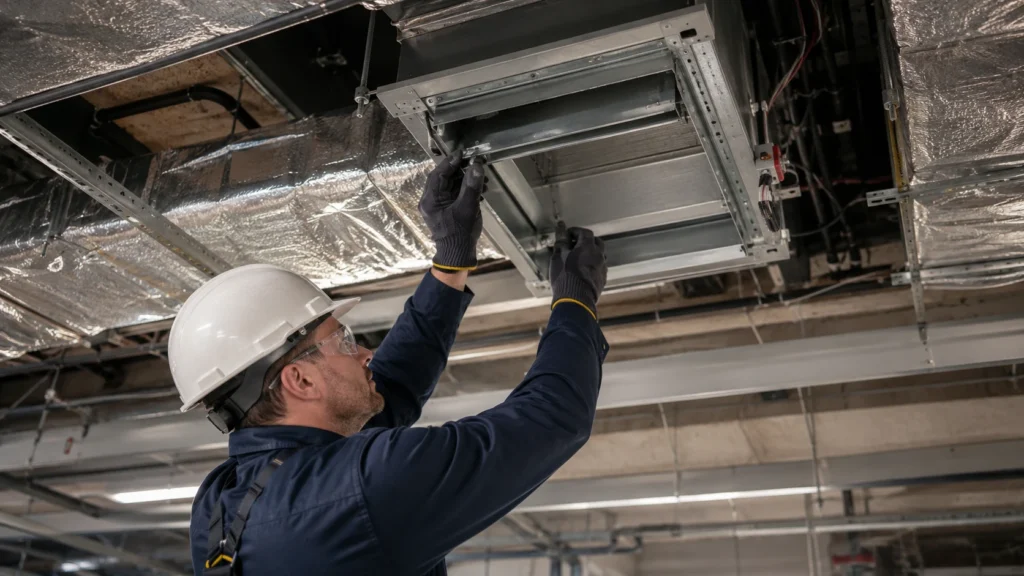
The technician starts with a visual inspection of each damper and its surrounding ductwork, checking for corrosion, damage, or anything obstructing the blade. Ceiling voids that have filled up with cabling or insulation since the last visit are a common culprit here, and it’s worth flagging before the drop test even starts.
Next comes the actuation test itself, sometimes still called a drop test out of habit, though for a genuine smoke damper this means triggering the control system signal and confirming the blade closes fully and seals correctly, not just releasing a spring-loaded mechanism. Airflow through the duct should stop cleanly once the damper shuts.
Any damper that sticks, closes partially, or responds late gets a clean and lubricate treatment on the spot where that resolves the fault. Where it doesn’t, that unit gets flagged for repair or replacement rather than reset and signed off anyway, which is the shortcut that causes most in-service failures.
Proper maintenance of fire and smoke dampers means those two responses stay separate: a fault fixed by cleaning is not the same outcome as one that needed a part replaced.
Every technician carrying out this work should be wearing appropriate personal protective equipment given the confined spaces and ductwork access involved, and every damper tested should be reset to its correct operating position before the visit ends.
What Should a Smoke Damper Test Report Include?
A test report that would actually hold up under scrutiny needs more than a tick box. At minimum it should record the damper’s location and asset ID, the date of the test, the inspector’s name, the result of the actuation test, any corrosion or damage noted, and the next due date for retesting.
Photographic evidence before and after any repair work gives a building owner something concrete to point to if an insurer or fire officer ever asks how the system is maintained.
Without that documentation, a smoke damper testing programme exists in theory but can’t be proven in practice, which in a dispute is functionally the same as it not existing at all. That gap tends to surface at the worst possible moment, after a fire, when an insurer is deciding whether to pay out or a fire officer is deciding whether the building owner met their duty, and a missing report leaves nothing to answer either question with.
What Happens When Smoke Damper Testing Is Deferred?
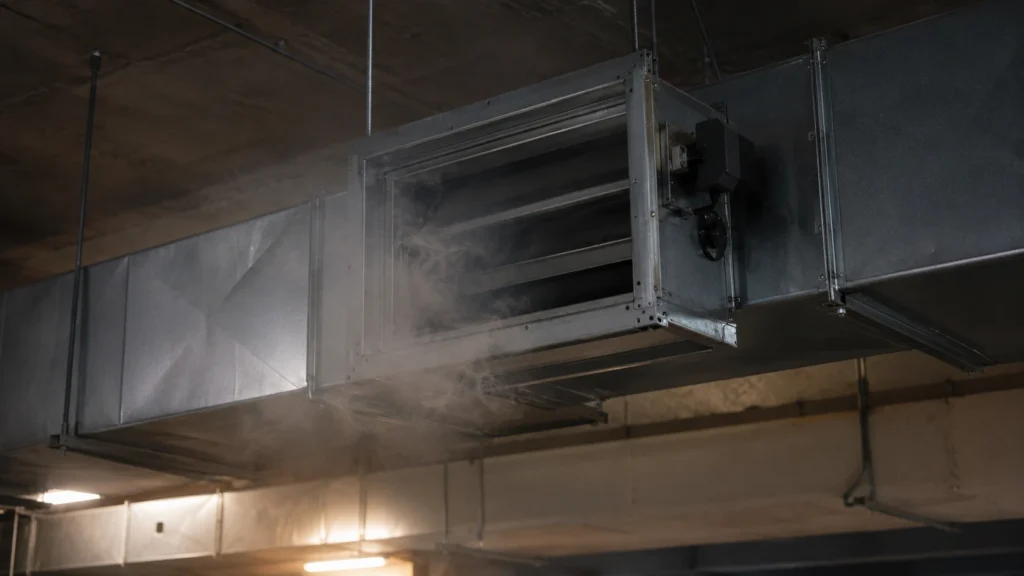
Smoke dampers don’t fail all at once. They fail quietly, over years, as corrosion sets into a blade that never gets exercised, or as ceiling void congestion makes access harder each time a maintenance window comes round. Deferred testing doesn’t remove the risk. It just moves the discovery of that risk to the worst possible moment, which is during an actual fire event.
The cost comparison here isn’t close. A scheduled testing and maintenance visit is a fixed, predictable cost.
A smoke control system that’s discovered to be non-functional after a fire, an insurance claim, or a fire officer’s inspection carries costs, from fire damage to a building shut down pending remedial work, that go well beyond the price of the damper itself, and that’s before accounting for the risk to building occupants that the system was supposed to protect in the first place.
If your building’s fire safety strategy includes smoke dampers, the decision in front of you isn’t whether they need testing. It’s whether that testing happens on your own schedule, or on a fire officer’s.
Indoor Vent specialises in exactly this gap: scheduled smoke damper testing, full EN 12101-8-aligned actuation checks, and reporting that holds up if anyone ever asks.
We maintain systems at this scale for public sector clients, including a 320-motor smoke and natural ventilation system for Roscommon County Council. If you’d like a clear picture of where your building currently stands, that’s a conversation worth having before the next fire risk assessment, not after it.