A fire damper inspection checklist covers five jobs: find the damper and reach it, read its label, check its condition, test how it closes, and record the result against its asset ID. The checklist is the easy part. The harder questions sit around it: what interval to inspect at, whose duty it is, and whether the figure you found online comes from an Irish source at all.
The Irish guidance quoted here comes from the Fire Safety Guide for Building Owners and Operators, prepared by the Department of Housing, Local Government and Heritage, and from Technical Guidance Document B (TGD B). Where they are silent, this page says so.

Do Fire Dampers Need to Be Inspected in Ireland?
Irish guidance recommends it, and the guide is addressed to the person having control of the premises, a role its own diagram says can sit with a facilities manager.
Section 18(2) of the Fire Services Acts 1981 and 2003 makes it the duty of every person having control over premises to which the section applies to take all reasonable measures to guard against the outbreak of fire.
It also makes it their duty to provide reasonable fire safety measures for those premises. The duty covers a wide range of premises types and excludes a dwelling house occupied as a single dwelling.
The guide describes fire and smoke dampers as active devices in HVAC ducts and says their inspection and maintenance should follow the recommendations in Section 8, Table 2.
Don’t look to TGD B for an interval, because it gives none for dampers. It states that the Building Regulations do not relate to the management of fire safety in buildings, and its guidance assumes that buildings and systems are maintained adequately.
If you manage a building or facility you do not own, the guide says shared responsibility should be clear to all parties and the lease should clearly identify where it lies. The person having control may delegate specific fire safety duties but should retain overall responsibility for ensuring they are carried out.

How Often Should Fire Dampers Be Inspected and Tested?
Table 2 of the guide has a row for fire and smoke dampers. It reproduces a note it attributes to I.S. EN 15650, Section 8.3: regular testing or inspection should be undertaken to meet regulatory requirements, or at intervals not exceeding six months. The guide does not set its own interval for fire damper testing. The note adds that some automatic systems may allow more frequent testing, at 48 hours or less, and this may be required by a national standard.
The verb is should, and the guide describes its own recommendations as advisory only and not statutory requirements. The note gives its two tests as alternatives.
Check what sits behind any interval you find online. BS 9999 is a UK standard and NFPA 80 is a US one. Neither is an Irish regulatory document.
Before you fix a schedule, ask your inspector which interval they are working to and which document it comes from. Write the answer in your register.
What Should a Fire Damper Inspection Checklist Include?
The table below sets out each check, from finding the damper on the register to logging the result. It is general good practice for dampers already in place, not a list taken from an Irish regulation.
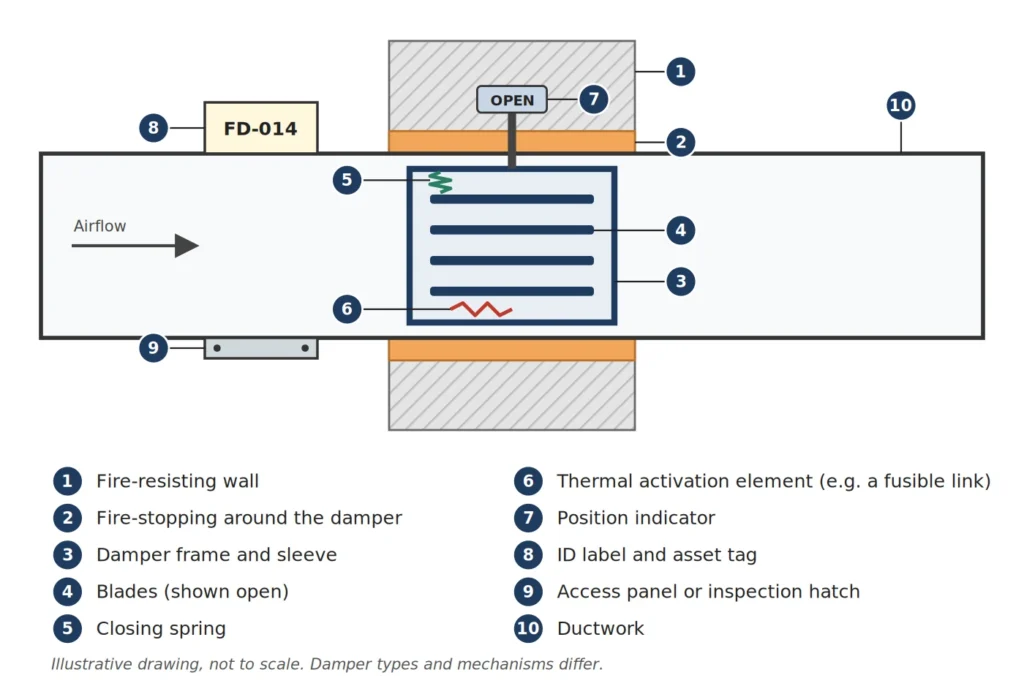
Illustrative drawing of a typical spring-operated fire damper. Other damper types differ.
| Check | Type | What to confirm |
| Register and ID | Visual | The damper has an entry with a unique ID and location, a legible label shows its type and rating, and the asset ID tag is in place |
| Access | Visual | A usable, marked access panel or hatch gives a clear route to the damper and its release mechanism |
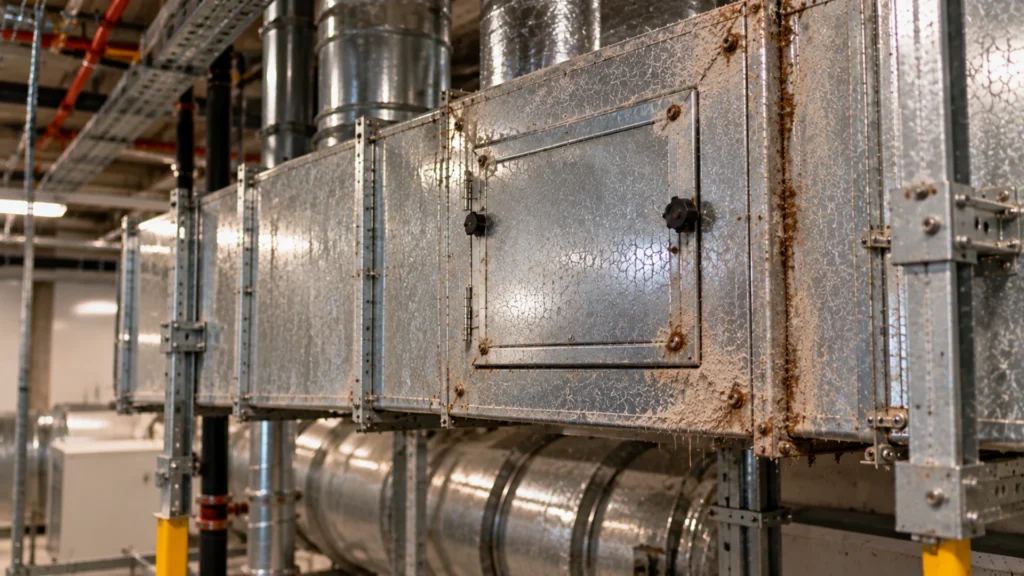
| Frame, sleeve and seal | Visual | No visible corrosion, water damage, distortion or missing fixings, and the fire-stopping around the damper looks intact |
| Obstructions | Visual | Blade, track and ductwork are clear of debris, with no cabling, insulation or new services in the way |
| Release mechanism | Visual and functional | Thermal activation element, such as a fusible link, present, undamaged and free of paint or coating, or the actuator and wiring intact and operational |
| Operation | Functional | The blade closes fully when released or triggered, holds closed and moves freely, with any springs and linkage free of binding, and any cleaning or lubrication follows the damper manufacturer’s instructions |
| Reset | Functional | Where the damper type allows, it reopens to its normal position, any fusible link is refitted and any indicator shows open |
| Result and records | Records | Pass or fail logged with date, inspector, defects, photographs and next due date |
TGD B’s design guidance says a damper should be suitably located and provided with an inspection hatch to facilitate inspection, testing and maintenance of both the damper and its actuating mechanism. A damper on your register that nobody can reach is a finding in itself. Our guide to fire and smoke damper installation explains how access is planned in at first fix.
This checklist covers the inspection and testing of fire dampers. Smoke dampers that close on a control signal are covered in our smoke damper testing guide.
The visual checks above show condition. The drop test shows whether the damper still functions.

What Does a Fire Damper Drop Test Involve?
A drop test has the inspector release the link or mechanism of a spring-operated damper and watch the blade close, then work through the Operation and Reset rows of the checklist.
Procedures vary with the damper type and the manufacturer’s instructions, and the guide’s own definition of a fire damper covers both mechanical and intumescent devices. Ask your inspector which procedure applies to each damper type in your building.
A damper that looks sound on the surface can still stick when released. A visual check cannot show that.
What Are the Signs a Fire Damper Is Faulty?
Any row in the checklist that fails is a sign of a faulty fire damper. The signs that only appear when the damper is released or triggered are a blade that sticks, closes slowly or stops short of fully closed.
Watch for grease. TGD B’s design guidance says dampers should not be used on extract ductwork serving kitchens, because the likely build-up of grease within the duct can adversely affect their operation. If you find a damper in that position, raise it with your inspector before you record a pass.
Who Should Inspect Fire Dampers?
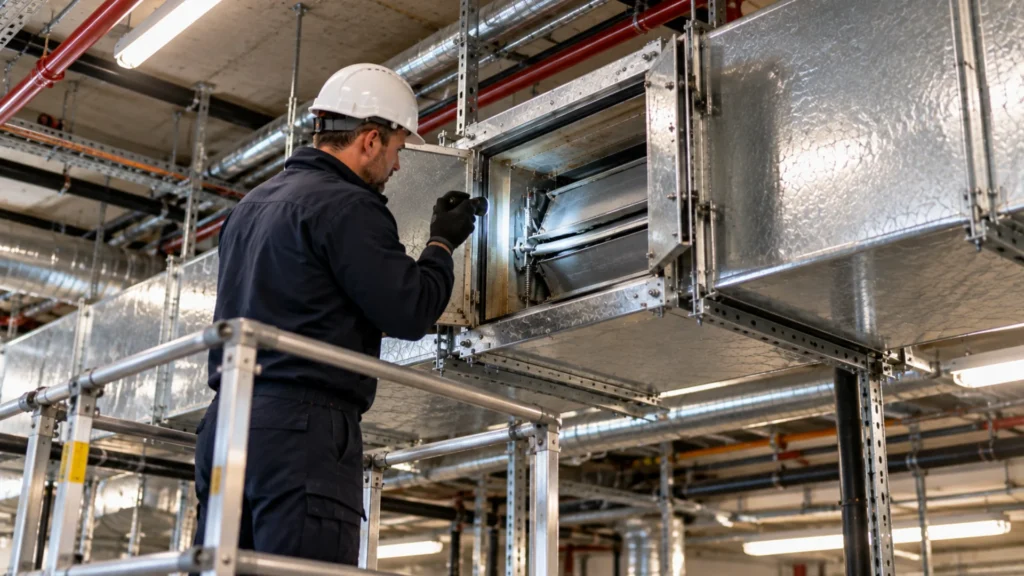
For planned periodic maintenance of fire protection systems, and for repairs to them, the guide says the person having control should engage competent persons. The guide does not name dampers in that sentence, but its Table 2 puts them in the planned inspection and maintenance category, which it says should be carried out by competent persons.
So the practical test is the inspector’s answers. Ask what training and experience they have on the damper types in your building, and what their report looks like.

What Fire Damper Records Should Building Managers Keep?
Your damper inspections and damper maintenance belong in the fire safety register. The guide sets out maintaining a register that schedules and records routine fire safety visual checks/inspections, training, fire drills, servicing and systems maintenance, and describes maintaining it as a means of demonstrating compliance.
Each damper needs a record like the one in the last row of the checklist, filed against its ID. A durable tag carrying that ID at the access point lets the next inspector verify the damper against its record.
| Damper ID and location | Date and inspector | Result | Defects noted | Next due |
| FD-014, L1 corridor, riser 2 | 08 Oct 2026, A. Sample | Pass | None. 2 photos | Per agreed schedule |
| FD-015, plant room wall | 08 Oct 2026, A. Sample | Fail | Blade stops short of fully closed. 3 photos | Retest after repair |
| FD-016, L2 stair lobby | 08 Oct 2026, A. Sample | Not tested | No usable access panel. 1 photo | Retest after access fitted |
A sample completed record. The data is invented.
Keep the handover documentation too. TGD B says the owner should be given a suitable set of operating and maintenance instructions for the active fire safety systems installed, though it does not name dampers in that passage.
If you have taken over a building, start by establishing which fire dampers are installed and what records came with them. Our guide to where fire and smoke dampers are required in Ireland covers the locations.
What to Do If a Fire Damper Fails Inspection?
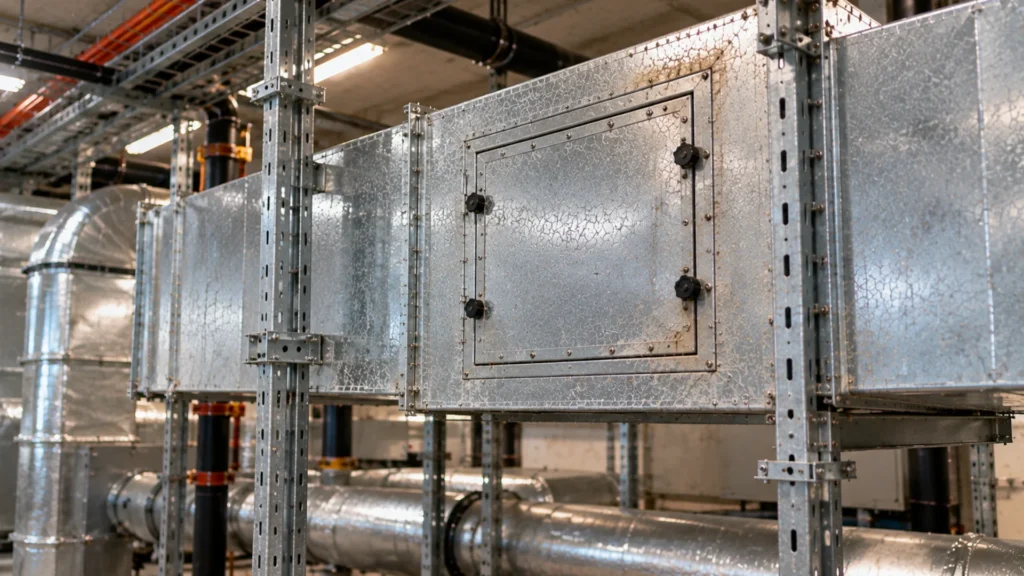
Record the failure with its ID, location and photographs, tag the damper as failed at the access point so nobody assumes it is working, tell the person having control, and arrange repair or replacement by a competent person. Then retest and record the result before you treat the item as closed.
If the repair cannot happen straight away, ask a competent person what interim fire safety measures the building needs. The guide notes that the local fire authority may give fire safety advice to a person having control.
The guide treats faults in fire safety systems as a life safety issue, not simply a maintenance issue to be dealt with later. It says they should be entered in the fire safety register and corrected promptly.
Frequently Asked Questions
A mechanical or intumescent device within a duct or ventilation opening, operated automatically in the event of fire to prevent the passage of fire. That is the guide’s glossary definition.
The guide’s Table 2 reproduces a note it attributes to I.S. EN 15650, saying regular testing or inspection should be undertaken to meet regulatory requirements, or at intervals not exceeding six months.
The person having control. Section 18(2) of the Fire Services Acts 1981 and 2003 places duties on whoever has control over premises to which the section applies. Where responsibility is shared, the guide says the lease should clearly identify where it lies.
TGD B’s design guidance says fire dampers should conform to I.S. EN 15650 and have an E classification equal to the integrity rating of the fire-resisting elements they pass through.
Our guide to where fire and smoke dampers are required in Ireland covers the locations and the TGD B basis.
Need Smoke Damper Testing in Ireland?
If your fire dampers sit alongside smoke control dampers, AOVs or a wider smoke ventilation system, smoke damper testing belongs in the same plan as this checklist. Indoor Vent supplies, installs and maintains smoke and natural ventilation systems for education, public sector and commercial buildings across Ireland, including smoke damper testing.
Could you show someone today the date, the result and the next due date for each damper in the building? Not yet? Start with the register. To find out where your damper records and smoke control maintenance stand, ring 01 727 0777.